

Garmin Forerunner 170 vs Garmin Forerunner 165: is it worth upgrading?
With the introduction of the Garmin Forerunner 170, Garmin has launched a successor to the popular Forerunner 165. At first glance, both running watches look very similar. They share almost the same size, an AMOLED display, and many identical sports and health features.
However, Garmin has made quite a few improvements under the hood. Especially for dedicated runners and athletes who want deeper insight into their training, the Forerunner 170 offers several interesting upgrades.
In this comparison, we take a closer look at all the differences between the Garmin Forerunner 170 and the Garmin Forerunner 165.
Screen and display
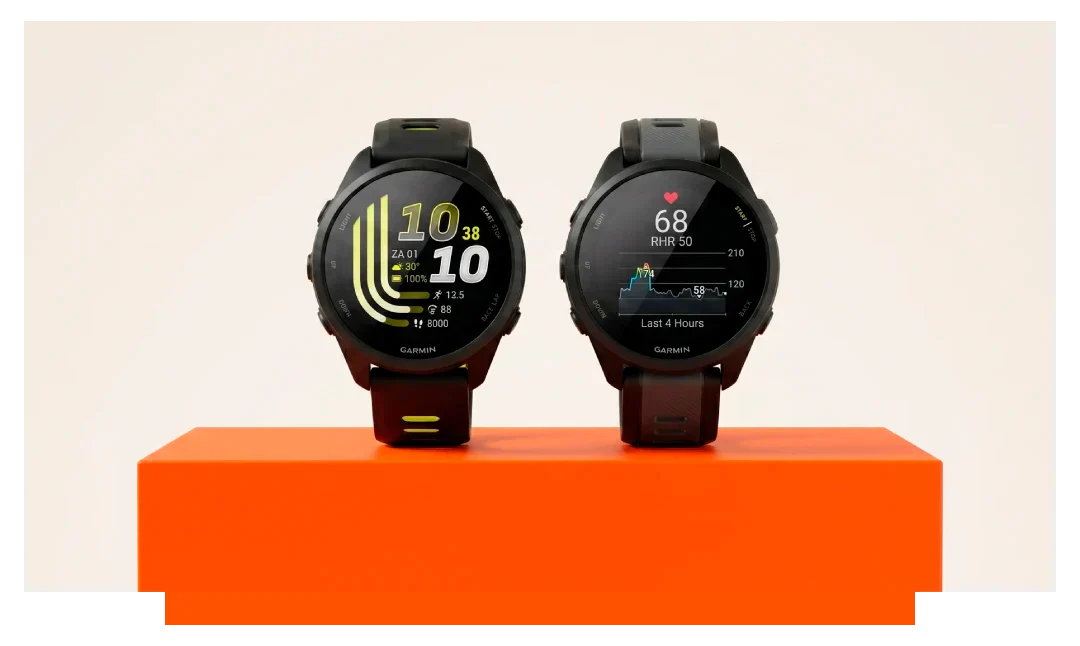
Anyone hoping for a larger or sharper screen on the Forerunner 170 will be disappointed. Garmin has chosen exactly the same display as on the Forerunner 165.
| Specification | Garmin Forerunner 165 | Garmin Forerunner 170 |
|---|---|---|
| Screen type | AMOLED | AMOLED |
| Screen size | 1.2 inch | 1.2 inch |
| Resolution | 390 x 390 pixels | 390 x 390 pixels |
| Touchscreen | Yes | Yes |
That is not a downside, however. The AMOLED display of the Forerunner 165 was already considered one of its strongest features thanks to its bright colours and excellent readability. The Forerunner 170 simply builds on this.
Design, materials and colours
Design-wise, the differences are also minimal. Both models feature a lightweight reinforced polymer case, a chemically strengthened glass screen, and interchangeable 20 mm quick-release straps.
The Forerunner 170 is slightly heavier at 41 grams compared to the Forerunner 165, which weighs around 39 grams. In practice, you will barely notice this difference during workouts. However, Garmin has equipped the Forerunner 170 with a refreshed interface and a more modern software experience.
Battery life
In terms of battery life, the differences are surprisingly small.
| Usage | Garmin Forerunner 165 | Garmin Forerunner 170 |
|---|---|---|
| Smartwatch mode | Up to 11 days | Up to 10 days |
| GPS mode | Up to 19 hours | Up to 20 hours |
The Forerunner 165 lasts slightly longer in smartwatch mode, while the Forerunner 170 has a small advantage during GPS workouts. For most users, this difference will not be decisive.
Health and sports features
This is where the Forerunner 170 really starts to stand out.
Both models include:
- Heart rate monitoring
- Sleep tracking
- Body Battery
- HRV Status
- Running Power
- Garmin Coach
- Recovery advice
- Training suggestions
- More than 80 sport profiles
However, Garmin has added several advanced training features to the Forerunner 170 that were previously mainly reserved for higher-end models.
Extra features on the Forerunner 170:
- Training Readiness
- Training Status
- Training Load analysis
- Advanced daily training suggestions
- Grade Adjusted Pace
- More extensive sport profiles
- New workout features
For athletes training towards events or aiming to improve performance more precisely, these are valuable additions.
Sensors
The biggest hardware upgrade is found in the sensors.
| Sensor | Garmin Forerunner 165 | Garmin Forerunner 170 |
|---|---|---|
| Optical heart rate sensor | Elevate Gen 4 | Elevate Gen 4 |
| GPS | Yes | Yes |
| Barometric altimeter | Yes | Yes |
| Compass | Yes | Yes |
| Gyroscope | No | Yes |
| Pulse Ox | Yes | Yes |
The addition of a gyroscope enables more accurate motion tracking and supports new smart features within Garmin’s software. Both models use the same Elevate Gen 4 heart rate sensor, so the Forerunner 170 does not measure heart rate more accurately, but it uses the data more intelligently thanks to its expanded training analysis.
Price differences
The Forerunner 165 has dropped significantly in price since the launch of the Forerunner 170.
| Model | Indicative price |
|---|---|
| Garmin Forerunner 165 | From approx. €249 |
| Garmin Forerunner 165 Music | From approx. €299 |
| Garmin Forerunner 170 | From approx. €299 |
| Garmin Forerunner 170 Music | From approx. €349 |
In many shops, the price gap is even larger as the Forerunner 165 is often discounted. This keeps the older model attractive for budget-conscious athletes.
At a glance
| Feature | Garmin Forerunner 165 | Garmin Forerunner 170 |
|---|---|---|
| AMOLED display | Yes | Yes |
| Screen size | 1.2 inch | 1.2 inch |
| Resolution | 390 x 390 | 390 x 390 |
| Smartwatch battery | 11 days | 10 days |
| GPS battery | 19 hours | 20 hours |
| Running Power | Yes | Yes |
| Garmin Coach | Yes | Yes |
| Training Readiness | No | Yes |
| Training Status | No | Yes |
| Training Load | No | Yes |
| Altimeter | Yes | Yes |
| Compass | Yes | Yes |
| Gyroscope | No | Yes |
| Garmin Pay | Music version only | Standard |
| Music storage | Music version only | Music version only |
| Weight | 39 g | 41 g |
| Starting price | ± €249 | ± €299 |
Where the Garmin Forerunner 170 is stronger
The Forerunner 170 feels mainly like a smarter version of the Forerunner 165. Garmin has not focused on major hardware changes, but rather on adding deeper training insights and software features.
Training Readiness and Training Status are the most important upgrades. These features help you better decide when to train, recover, or take a rest day. Garmin Pay is also included as standard, whereas on the Forerunner 165 you need the more expensive Music version.
For athletes who take their training seriously, the Forerunner 170 simply provides more data and guidance.
Conclusion
The Garmin Forerunner 165 remains an excellent running watch in 2026. You still get a bright AMOLED display, accurate GPS, extensive health tracking, and solid battery life at a competitive price.
However, the Garmin Forerunner 170 shows that Garmin has listened closely to dedicated athletes. With features like Training Readiness, Training Status, a gyroscope, and standard Garmin Pay, it feels noticeably more complete.
If you already own a Forerunner 165, upgrading is not strictly necessary. But if you are planning to buy a new Garmin watch and want more advanced training insights for the years ahead, the Forerunner 170 is clearly the more future-proof choice.
Frequently asked questions
What is the biggest difference between the Garmin Forerunner 165 and 170?
The Forerunner 170 includes extra training features such as Training Readiness, Training Status, and a gyroscope for more detailed analysis.
Are the straps interchangeable?
Yes, both the Garmin Forerunner 170 straps and Forerunner 165 straps use 20 mm quick-release bands and are compatible with both models.
Do both models have the same screen?
Yes, both feature a 1.2-inch AMOLED display with a resolution of 390 x 390 pixels.
Is heart rate tracking better on the Forerunner 170?
No, both models use the same Garmin Elevate Gen 4 heart rate sensor.
Is battery life better on the Forerunner 170?
Not really. The differences are small. The Forerunner 165 performs slightly better in smartwatch mode, while the Forerunner 170 lasts a bit longer in GPS mode.
Is Garmin Pay available on both models?
On the Forerunner 165 only via the Music version. On the Forerunner 170, Garmin Pay is included as standard.
Is the Garmin Forerunner 170 worth the extra cost?
For athletes who use training analytics, recovery insights, and detailed performance data, the extra cost is generally easy to justify.