


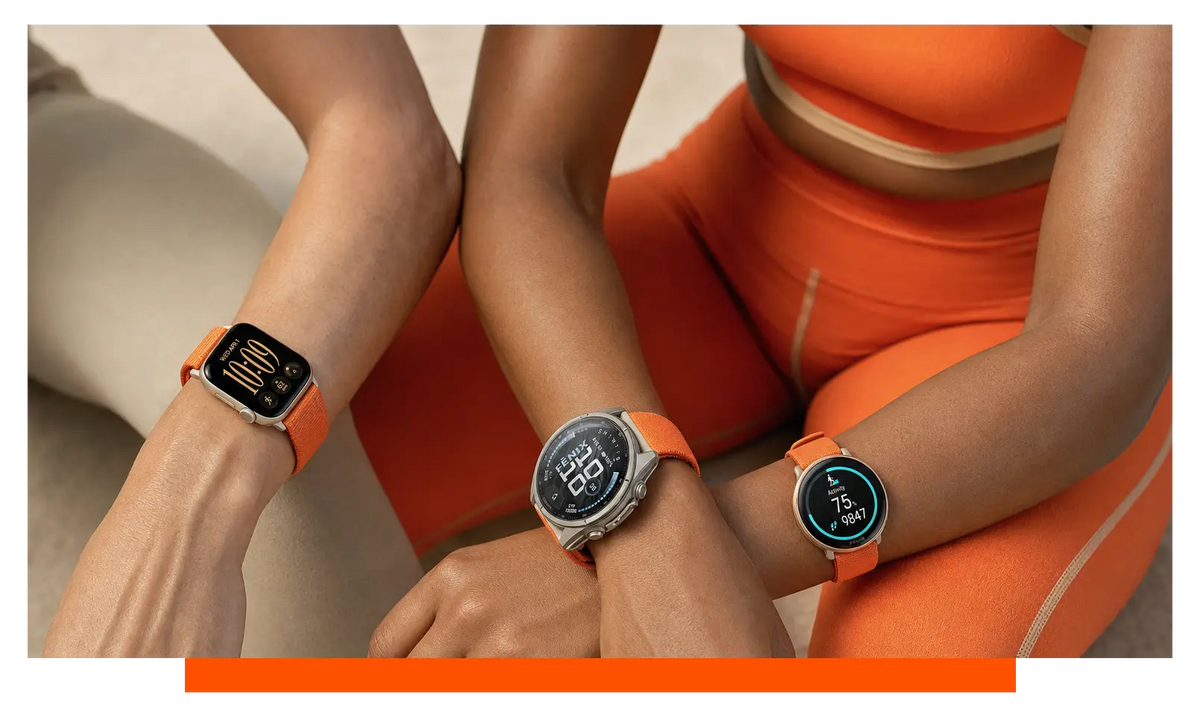
Apple Watch Series 12 is the best strength-training smartwatch for iPhone lifters who want the least-friction route to a proper lifting log. Choose Garmin Fenix 9 instead if you want the watch itself to run a structured programme, explain your recovery and support serious outdoor training too.
At a glance
Apple Watch Series 12 offers the most natural route into dedicated lifting apps on an iPhone, while Garmin Fenix 9 is the stronger choice when the watch must sit at the centre of a broader training plan.
| Smartwatch | Best for | Endurance | Strength workflow | Recovery view | Case size | Weight | Case material |
|---|---|---|---|---|---|---|---|
| Apple Watch Series 12 | iPhone training | Up to 24 hours | Dedicated lifting apps | Readiness app | 42mm / 46mm | 30.3-52.9g | Aluminium / titanium / ceramic |
| Garmin Fenix 9 | Ultra-endurance outdoors | Up to 29 days | Watch-led programme | Training readiness | 43mm / 47mm / 51mm | 61-91g | Fibre-reinforced polymer / titanium |
| Polar Vantage M3 | Daily workout guidance | Up to 7 days | Work-Rest guide | Cardio load | 44mm | 53g | Plastic / stainless steel |
| Coros Pace 4 Pro | GPS-heavy running | 60 hrs GPS | Programmed rests and Auto Advance | Fitness and fatigue | 47.6 × 47.6 × 11.8mm | 43g | Titanium alloy |
| Amazfit T-Rex 3 Pro | Rugged hiking | Up to 25 days | 25 strength movements | BioCharge | 44mm / 48mm | 46.8g / 52g | Fibre-reinforced polymer / Grade 5 titanium |
The thesis: your choice turns on whether the watch must run the lifting programme or simply provide a comfortable, reliable record for the lifting app and routine you already prefer.
What makes a good strength-training smartwatch
A good strength-training smartwatch keeps the next set, rest period and session record easy to manage without making you spend the workout tapping at your wrist.
Low-friction workout control
A fixed programme works best with clear prompts for the next exercise, set and rest period. If you frequently change exercise order because a rack or machine is occupied, editing and advancing the session quickly matters more than a long list of exercise names.
Automatic set and rep tracking is useful as a convenience, not an unquestionable record. Gripping, partial repetitions and machine movements can all make automatic detection less dependable, so the better question is whether you can correct the log without losing your rest period.
Recovery guidance you can understand
Readiness, load and fatigue tools are most useful when they make a practical distinction between training hard and arriving at the gym under-recovered. They should add context to how you feel, not overrule it.
This factor becomes more important when lifting shares the week with running, cycling or trail sport. A watch that sees the wider training picture can help you judge whether a poor session reflects local muscle fatigue, a heavy overall load or simply an off day.
Enough battery for sleep and gym sessions
Battery endurance matters because recovery features lose context if you regularly remove the watch overnight to charge it. Long endurance also helps when strength work is only one part of a schedule containing GPS-heavy outdoor sessions.
That does not make the longest-lasting watch automatically best. If a short daily charge fits your routine and the app workflow is markedly better, convenience during the workout can outweigh days of extra endurance.
Stable, comfortable sensor contact
Wrist heart rate is most useful as an effort trend during lifting because gripping, wrist movement and muscle tension can disturb the optical signal. Wear the watch comfortably snug and at least a finger-width above the wrist bone to limit movement at the sensor.
Case shape and strap choice matter here. A smaller or lighter watch is less likely to catch on wrist wraps, while a pliable strap is easier to tighten without creating a pressure point. If a kettlebell, bar or lifting strap comes close to the case, moving the watch slightly higher can protect it and preserve sensor contact.
Best for iPhone training - 1. Apple Watch Series 12
Apple Watch Series 12 is the best choice for an iPhone lifter who wants to use a dedicated lifting app rather than build the whole programme around the watch maker’s own training system.
That approach is particularly good when your sessions change on the fly. You can use the lifting workflow you prefer, record the workout and then view readiness and training context alongside the rest of your daily activity. Its relatively light case options also make it less intrusive during front-rack holds, kettlebell work and sessions involving wrist wraps.
- Endurance: up to 24 hours
- Case options: 42mm or 46mm
- Weight range: 30.3-52.9g
- Recovery feature: Readiness app
- Price: £369 at the time of writing
Strap choice strengthens that comfort advantage. Silicone, nylon, leather, Milanese and metal Apple Watch 12 straps are available, although soft silicone or nylon is the practical gym choice when you want close sensor contact without a rigid link pressing into your wrist.
The compromise is charging frequency. It has the shortest stated endurance in this shortlist, so it suits someone happy to build a brief charge into an established daily routine.
Best for an all-sport training plan - 2. Garmin Fenix 9
Garmin Fenix 9 is the best option when strength training is part of a larger programme and you want the watch to provide structured guidance, training readiness and deep outdoor support.
Its advantage is context. If your week combines lifting with long runs, hiking or multisport training, its readiness view and up to 29 days of endurance make it easier to keep wearing the watch through training, sleep and recovery. Multi-band GPS and built-in mapping are not deciding factors inside the gym, but they make the premium easier to justify when you regularly train outdoors as well.
- Endurance: up to 29 days
- Case options: 43mm, 47mm or 51mm
- Weight range: 61-91g
- Recovery feature: Training readiness
- Prices: the 43mm model is £859.99, the 47mm model is £859.99 and the 51mm model is £949.99 at the time of writing
Fit needs more thought than it does with a lighter watch. The separate selections of Garmin Fenix 9 - 43mm straps, Garmin Fenix 9 - 47mm straps and Garmin Fenix 9 - 51mm straps mean you need to match the strap to the case. Silicone, nylon, leather, Milanese and metal choices are available for every listed size; flexible silicone or nylon makes the most sense for lifting.
Choose the case conservatively if wrist wraps are part of every session. The larger versions provide the same broad training philosophy, but their extra physical presence can be noticeable when your wrist is bent under load.
Best for rest-led lifting - 3. Polar Vantage M3
Polar Vantage M3 is the clearest choice if your main frustration is deciding when to begin the next set rather than following a complicated exercise list.
Its Work-Rest guide reads your heart rate during strength work and alerts you when you are ready to go again. That is a genuinely useful watch-led interaction: it reduces clock-watching without pretending that every repetition can be identified perfectly.
- Endurance: up to 7 days
- Case size: 44mm
- Weight: 53g
- Strength feature: Work-Rest guide
- Price: £349 at the time of writing
The single case size keeps the choice straightforward. Silicone, nylon, leather, Milanese and metal Polar Vantage M3 straps are available, so you can use a washable, close-fitting option for the gym and reserve a dressier strap for daily wear.
This is the watch for a lifter who values pacing over micromanagement. It guides the rhythm of the session while leaving you free to swap exercise order when the gym is busy.
Best for runners who also lift - 4. Coros Pace 4 Pro
Coros Pace 4 Pro is the strongest fit for a runner who wants structured strength sessions and programmed rests without giving up a light, GPS-focused training watch.
Pre-planned workouts, programmed rest periods and Auto Advance reduce the amount of input needed between sets. That suits a fixed programme especially well: follow the prompt, complete the work and let the session move on.
- GPS endurance: 60 hrs
- Case: 47.6 × 47.6 × 11.8mm
- Weight: 43g
- Peak brightness: 3,500 nits
- Price: £389 at the time of writing
The low weight is valuable under a bar even though the case is broad. A snug nylon or silicone option from the range of Coros Pace 4 Pro straps can reduce sensor movement, while leather, Milanese and metal choices cover less active daily wear.
Its bright display is also easy to glance at when training outdoors. If running remains your main sport and strength work supports it, the balance of structured gym guidance, low weight and GPS endurance is persuasive.
Best for rugged hiking and gym use - 5. Amazfit T-Rex 3 Pro
Amazfit T-Rex 3 Pro is the practical choice if you want a rugged hiking watch that can also recognise a defined selection of strength movements.
Its strength mode covers 25 movements, while BioCharge provides a readiness-style view and the battery lasts up to 25 days. Offline global topographic maps and support for several satellite positioning systems push it towards hikers who lift, rather than lifters who only need a compact gym companion.
- Endurance: up to 25 days
- Case options: 44mm or 48mm
- Weight: 46.8g or 52g
- Peak brightness: up to 3,000 nits
- Prices: the 44mm model is £399.99 and the 48mm model is £399.99 at the time of writing
Choose the case before the strap: Amazfit T-Rex 3 Pro - 44mm straps and Amazfit T-Rex 3 Pro - 48mm straps use separate fitments. The smaller case is likely to be easier to position above wrist wraps, while the larger version prioritises an easy outdoor glance.
Which strength-training smartwatch should you choose?
Choose according to who controls the programme: your preferred phone app, the watch itself or a wider running and outdoor training plan.
- If you lift with an iPhone and already know how you want to log sessions: choose Apple Watch Series 12 for the least-friction app-led route.
- If lifting sits inside a serious all-sport schedule: choose Garmin Fenix 9 for watch-led planning, readiness context and long endurance.
- If your rest periods determine the quality of the session: choose Polar Vantage M3 for its Work-Rest guidance.
- If running is your main sport but you follow fixed strength sessions: choose Coros Pace 4 Pro for pre-planned workouts, programmed rests and low weight.
- If hiking comes first and gym work supports it: choose Amazfit T-Rex 3 Pro for rugged outdoor features and its defined strength-movement support.
- If you train with wrist wraps or bring the watch close to a bar or kettlebell: favour the smaller or lighter suitable case, then use a flexible strap and position the sensor above the wrist bone.
For most iPhone lifters, Apple Watch Series 12 remains the easiest route to a useful lifting log. Garmin Fenix 9 earns the upgrade when you want the watch - not your phone app - to sit at the centre of strength work, recovery and outdoor training.
Frequently asked questions
Here are the practical answers to common questions that arise once you start recording strength sessions.
Do smartwatches calculate calories accurately for weight training?
No. Treat lifting calories as a rough consistency metric, not a number to eat back or use for precise weight control, because short efforts, rest periods and local muscle work do not map neatly to heart rate.
Do I need a chest strap for lifting?
No, a chest strap is optional. It is worthwhile when you want the steadiest possible heart-rate record for hard lifting, intervals or recovery guidance, but it will not make calorie estimates or automatic rep counts precise.
Should I pause the workout between sets?
No. Keep the workout running through normal rests so it records both work and recovery; pause only when you want the recording itself to stop during a long interruption.
Does a strength workout contribute to recovery and training-load scores?
Yes, when you record the session with heart-rate data. Apple Watch compares workout intensity and duration over time, COROS includes recorded workouts in load, fitness and fatigue, Polar records cardio load, and Amazfit calculates training load and recovery time from workout data.


