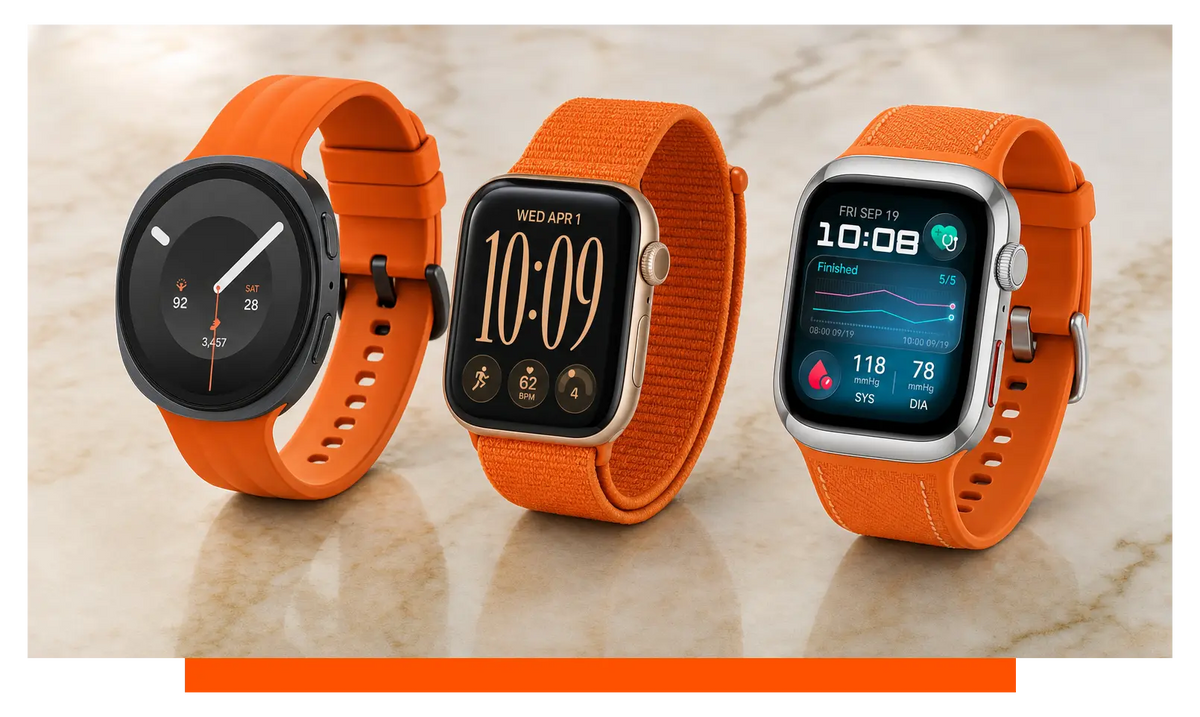




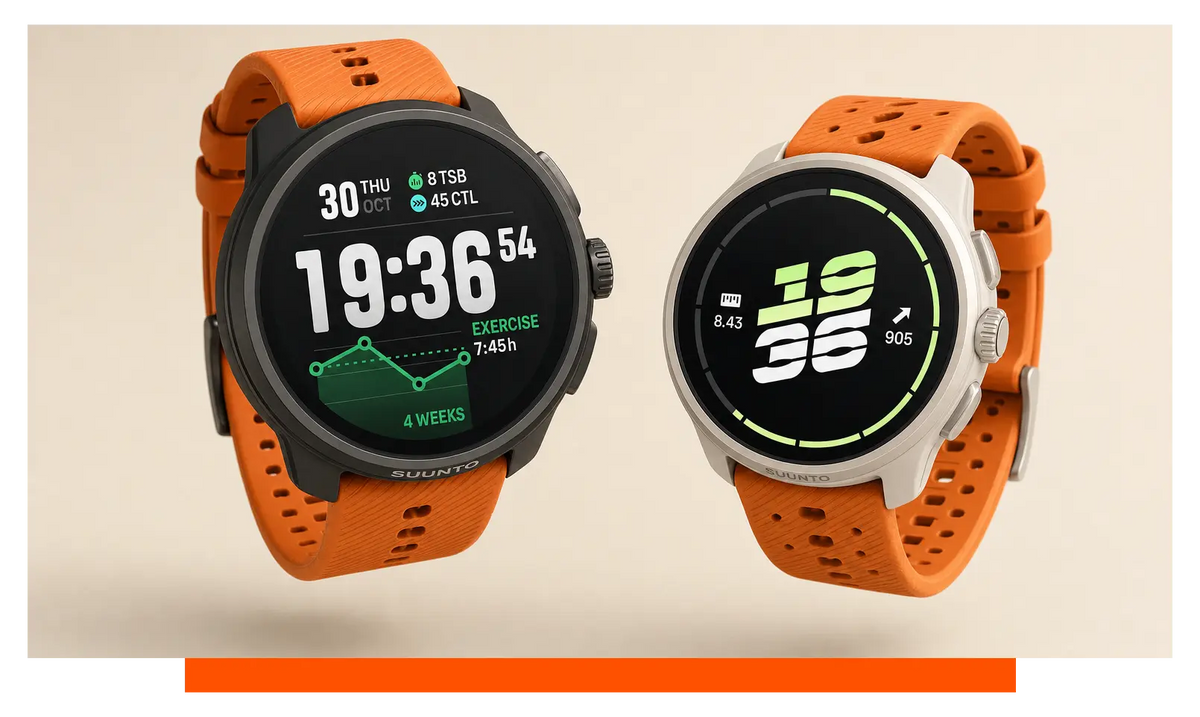
Choose the Suunto Race 3s if comfort on a smaller wrist, during sleep and through everyday wear matters most. Pick the Suunto Race 2 if you genuinely need its larger display and longer GPS battery life. The decision is whether that extra endurance justifies wearing a more substantial watch around the clock.
On this page
- The short version
- Suunto Race 2 and Race 3s specifications compared
- Which Suunto feels more comfortable on a smaller wrist?
- Suunto Race 2 vs Race 3s: battery life
- Suunto Race 2 vs Race 3s: display and maps
- Offline music, storage and coaching
- Navigation and satellite positioning
- Suunto Race 2 vs Race 3s: training and sport modes
- Health, sleep and recovery tracking
- Water resistance and durability
- The Suunto app and everyday use
- Where Suunto Race 2 is better
- Where Suunto Race 3s is better
- Who should choose which
- Frequently asked questions
The short version
- Comfort: Race 3s has the smaller, slimmer and lighter case, so it is less likely to feel intrusive on a smaller wrist or in bed.
- Battery: Race 2 records for up to 55 hours in its best-accuracy dual-band GPS mode, against up to 38 hours for Race 3s.
- Display: Race 2 gives you a 1.5-inch screen rather than the 1.32-inch display on Race 3s. Both have the same peak brightness and resolution.
- Training tools: Choosing Race 3s does not cost you offline maps, dual-band positioning, structured training, sleep tracking, HRV tracking or recovery guidance.
- Music and coaching: Race 3s adds offline music, 64GB of storage and 3 months of Suunto AI Coach access.
- Price: At the time of writing, Suunto Race 2 was £429, while Suunto Race 3s was £435. The small gap makes fit and battery more important than price.
The deciding trade is simple: Race 3s is easier to live and sleep with, while Race 2 earns its larger case through a bigger view and more untethered training time.
Suunto Race 2 and Race 3s specifications compared
The specifications point to fit rather than missing training features as the meaningful divide: Race 3s packages the shared essentials into a less intrusive watch, while Race 2 makes room for a larger display and longer GPS recording.
| Specification | Suunto Race 2 | Suunto Race 3s |
|---|---|---|
| Case dimensions | 49 x 49 x 12.5 mm | 46 x 46 x 11.4 mm |
| Weight and profile | 76 g / 65 g | 56 g |
| GPS battery life | Up to 55 hours | Up to 38 hours |
| Display size | 1.5 inches | 1.32 inches |
| Offline music storage | No | Yes |
| Coaching access | Suunto Coach | 3 months Suunto AI Coach |
| Price at the time of writing | £429 | £435 |
| Storage capacity | 32GB | 64GB |
| Water resistance | 100 m | 5 ATM |
| Sport modes | 115+ | 120+ |
| Display technology | AMOLED | AMOLED |
| Peak brightness | 2,000 nits | 2,000 nits |
| Display resolution | 466 x 466 | 466 x 466 |
| Satellite positioning | Dual band (L1+L5) | Dual band (L1+L5) |
| Offline maps | Yes | Yes |
| Cover glass | Sapphire crystal | Sapphire crystal |
| Wrist heart rate | Yes | Yes |
| Sleep tracking | Yes | Yes |
| HRV tracking | Yes | Yes |
| Companion app | Suunto app | Suunto app |
Unless your events or charging habits demand the Race 2’s extra GPS endurance, the Race 3s gives up surprisingly little to achieve its easier all-day fit.
Which Suunto feels more comfortable on a smaller wrist?
Suunto Race 3s is the more comfortable choice for a smaller wrist, sleep tracking and continuous everyday wear.
Its case measures 46 x 46 x 11.4 mm, compared with 49 x 49 x 12.5 mm for Race 2. Those differences affect more than appearance. The shorter case is less likely to spread beyond a narrow wrist, while the slimmer profile is less prone to catching on a cuff or pressing into your wrist when you sleep with your arm tucked under a pillow.
Weight strengthens that advantage. Race 3s is listed at 56 g, whereas Race 2 is listed in 76 g and 65 g configurations. Race 2 is not unreasonably heavy for a rugged training watch, but you are more likely to remain aware of it after your session has ended. That matters if sleep and HRV trends depend on you actually wearing the watch overnight.
The strap can refine the fit further. Race 2 uses widely available 22mm quick-release straps, making it straightforward to move between a secure training band and something softer for everyday wear. The current Suunto Race 2 straps range includes silicone, nylon, leather, Milanese, metal and titanium options. Nylon can reduce the rigid feel around a smaller wrist, while silicone remains practical when sweat and regular washing are priorities.
Race 3s strap choices currently include silicone, nylon, leather, Milanese and metal. Browsing Suunto Race 3s straps gives you room to tune its already compact fit for training, commuting or smarter everyday wear.
On your wrist, Race 3s feels more like an all-day health and training companion; Race 2 feels like the more substantial outdoor instrument.
Suunto Race 2 vs Race 3s: battery life
Suunto Race 2 is the better choice when long GPS sessions and fewer charging interruptions matter more than compactness.
In the best-accuracy dual-band GPS mode most relevant to runners, riders and hikers who care about track quality, Race 2 lasts up to 55 hours. Race 3s reaches up to 38 hours in its equivalent mode. That is the clearest functional return for accepting the larger Race 2 case.
Race 3s still covers ordinary runs, gym sessions, day hikes and many endurance events comfortably. Its limitation becomes more meaningful when you record very long races, spend several days away from a charger or routinely forget to top up before training. In those situations, Race 2 gives you a wider buffer rather than merely a better number on paper.
Your charging routine matters too. If the watch comes off while you shower or sit at a desk, Race 3s may never feel restrictive. If you want to wear it continuously for recovery data and only think about charging occasionally, Race 2’s extra reserve has practical value - but only if its larger shape does not make you remove it overnight.
That is the central tension in this comparison. Battery endurance is useful only when you keep wearing the watch; the compact model may collect more complete sleep and recovery data simply because it is less noticeable.
During a long recorded activity, you would notice Race 2’s extra safety margin. During an ordinary training week, Race 3s is likely to feel more convenient on the wrist than limiting on the charger.
Suunto Race 2 vs Race 3s: display and maps
Suunto Race 2 has the more readable display while moving, but Race 3s retains the same core map and navigation capability in a smaller format.
Race 2 uses a 1.5-inch AMOLED display, giving maps, data fields and menu elements more physical room. Race 3s has a 1.32-inch AMOLED display. If you regularly glance at several metrics while running, follow twisting trails or check a route while riding, the larger Race 2 screen is easier to justify.
Both displays reach 2,000 nits and use a 466 x 466 resolution. You are therefore not choosing a dimmer or coarser display with Race 3s; you are choosing the same pixel grid in a physically smaller viewing area. Both also use sapphire crystal, which is reassuring for a watch likely to meet rock, gym equipment, desks and door frames.
The larger screen is not automatically better for every buyer. On a smaller wrist, the extra viewing area comes attached to the case dimensions you will feel throughout the day and night. If you mostly start a workout, check pace or heart rate at a glance and review the detail later in the Suunto app, Race 3s gives you enough screen without demanding as much wrist space.
Choose Race 2 for frequent on-watch map reading and dense training screens. Choose Race 3s if the display is mainly a quick window into your workout rather than the centre of your navigation routine.
Mid-run, Race 2 makes information easier to pick out quickly; away from training, Race 3s keeps that information in a tidier package.
Offline music, storage and coaching
Race 3s is the stronger watch for phone-free music and the newer coaching offering.
It can store offline music, while Race 2 cannot. That lets you leave your phone behind and listen through paired Bluetooth headphones, which is useful for running, gym work or commuting without another device in your pocket. Race 3s also has 64GB of storage against 32GB in Race 2, giving its music feature meaningful room alongside maps and watch data.
Coaching differs as well. Race 2 provides Suunto Coach, while Race 3s includes 3 months of Suunto AI Coach access. The latter is worth considering if adaptive guidance is likely to influence how you plan and adjust training rather than simply decorate the app. Continued access after the included period requires a paid subscription, so it should not outweigh fit, maps or battery unless you expect to use it consistently.
Race 2 remains a capable choice for athletes who already follow a plan, work with a coach or prefer to interpret their own training data. Its lack of onboard music is more decisive: if phone-free listening forms part of every run, Race 3s is plainly better suited.
In everyday use, Race 3s can replace both a music player and some manual training planning. Race 2 keeps its focus on longer recording and a larger view.
Navigation and satellite positioning
Navigation is not a reason to avoid Race 3s because both watches provide offline maps, dual-band positioning and route guidance.
Each model uses dual-band L1+L5 satellite positioning. That is especially helpful where buildings, tree cover or steep terrain make satellite reception more difficult, because the watch has more positioning information available than a basic single-band system. Both also support routes and points of interest, so the compact model is not a stripped-back road-running watch.
The practical distinction returns to screen size and battery. Race 2 is easier to consult when the route has several close turns or when you want more map context without stopping. Its longer best-accuracy GPS endurance also suits prolonged navigation away from power. Race 3s calculates and stores the essential navigation information, but presents it on the smaller display and with less recording headroom.
If you occasionally follow a downloaded hiking route, use breadcrumb-style guidance or need reassurance at an unfamiliar junction, Race 3s should not feel like a compromise. Race 2 becomes worthwhile when map reading is frequent and sustained rather than an occasional check.
At a confusing trail junction, both can guide you; Race 2 simply gives your eyes more room and your battery more reserve.
Suunto Race 2 vs Race 3s: training and sport modes
Race 3s gives up no meaningful core training capability and actually carries the broader listed sport-mode selection.
Race 2 supports 115+ sport modes, while Race 3s supports 120+. That small difference should not decide the purchase by itself. What matters is that both cover broad multisport use and support structured training, so runners, cyclists and gym users are not being pushed towards the larger model simply to access serious workout tools.
Both watches can guide planned sessions created in the Suunto app, with workout information available on the wrist. Race 2 also supports interval setup and on-watch guidance. The compact Race 3s therefore remains suitable if you train several times a week, follow a progression or want your sessions recorded within the same Suunto ecosystem.
The differences around training are physical rather than foundational. Race 2 is easier to read at speed and lasts longer during extended GPS recording. Race 3s is lighter during arm movement and less intrusive once the session finishes. That can make it the more balanced option if your week mixes training with office wear, commuting and sleep tracking.
For a long ultra-distance day, Race 2’s battery and display are tangible advantages. For regular structured workouts followed by continuous recovery tracking, Race 3s is likely to disappear more readily into your routine.
Health, sleep and recovery tracking
Both watches cover the important health and recovery tools, but Race 3s has the better shape for collecting them consistently.
Race 2 and Race 3s both provide wrist heart rate, sleep tracking and HRV tracking. Race 3s also retains recovery tools rather than treating its smaller case as a reason to pare back the software. You are not sacrificing the essentials used to judge whether training, stress and rest are moving in the right direction.
Comfort is the hidden specification here. Sleep and recovery features only produce a useful pattern when the watch stays on your wrist. Race 3s is slimmer, lighter and less broad, which makes it the safer choice if you are sensitive to pressure in bed or have previously abandoned overnight tracking because a sports watch felt bulky.
Race 2 can still serve as a capable continuous tracker, particularly on a broader wrist. Its larger battery may also reduce interruptions to your routine. Yet that advantage disappears if the case prompts you to take it off each night.
Optical heart-rate readings are best treated as fitness guidance rather than medical measurements. A secure fit against bare skin matters, and rapidly changing effort can be harder for wrist sensors to follow than steady exercise.
When the lights go out, Race 3s is the model you are less likely to notice - and therefore more likely to keep wearing.
Water resistance and durability
Race 2 has the stronger stated water-resistance specification, while both watches use scratch-resistant sapphire crystal.
Race 2 is rated to 100 m, whereas Race 3s carries a 5 ATM rating. That gives Race 2 the clearer margin if your watch regularly faces demanding water use, rough outdoor conditions or repeated exposure during adventure training. Race 3s remains intended for swimming and snorkelling, but neither model should be treated as a scuba dive computer.
The shared sapphire crystal matters in ordinary life. It reduces the concern of brushing the display against rock, metal gym equipment or a hard desk edge. The case choice still changes how often those impacts happen: Race 3s sits closer to the wrist, while the larger Race 2 presents a broader target.
Strap material should match the environment as well. Silicone is practical when the band will be soaked and washed frequently. Nylon can feel softer for long dry sessions but needs time to dry after getting wet, while leather is better kept for commuting and smarter everyday wear.
Around water, Race 2 gives you the more reassuring rating. Around sleeves, doorways and daily knocks, Race 3s benefits from its lower-profile fit.
The Suunto app and everyday use
Both watches use the Suunto app, so the choice does not force you into a different training platform.
The app is where activities, routes, structured workouts and longer-term trends come together. That shared foundation makes moving between these watches less disruptive and means the buying decision can stay focused on wrist fit, display, music and battery rather than software migration.
Race 3s feels more flexible away from training because it combines the smaller case with offline music and more storage. Race 2 takes the opposite approach: it is a more substantial outdoor watch with a larger screen and longer recording endurance. Both handle the expected flow between watch and app, including activity syncing, notifications and updates.
If you spend most of your time analysing sessions on your phone, the Race 2 display advantage becomes less important. If you prefer to inspect maps and data directly on the watch while moving, its larger screen has a clearer purpose.
Once the workout is synced, the experience is broadly familiar on either model. The difference is how much watch you want to wear while gathering the data.
Where Suunto Race 2 is better
Suunto Race 2 is better when screen space and endurance directly support the way you train.
- Long GPS sessions: up to 55 hours in best-accuracy dual-band mode gives you more headroom for long events and adventures.
- On-watch readability: the 1.5-inch display is easier to scan for maps and several training fields while moving.
- Water-resistance margin: the stated 100 m rating is stronger than the Race 3s specification.
- Strap fitment: its 22mm quick-release connection makes replacement and style changes straightforward.
- Premium strap choice: the available range includes titanium as well as silicone, nylon, leather, Milanese and metal options.
Where Suunto Race 3s is better
Suunto Race 3s is better when comfort and phone-free everyday versatility matter most.
- Smaller-wrist fit: its 46 x 46 x 11.4 mm case takes up less room than Race 2.
- Lower weight: 56 g makes it less intrusive for sleep, commuting and all-day wear.
- Offline listening: music can be stored on the watch and played through Bluetooth headphones.
- Storage: 64GB provides more room than the 32GB available on Race 2.
- Coaching: it includes 3 months of Suunto AI Coach access.
- Sport selection: its 120+ listed modes slightly exceed the 115+ available on Race 2.
Who should choose which
Race 3s suits most buyers who prioritise comfort, while Race 2 is the specialist choice for longer recording and more glanceable information.
- Choose Suunto Race 2 if you enter long events, spend extended periods away from charging or regularly navigate from the watch while moving.
- Choose Suunto Race 2 if your wrist comfortably carries a substantial sports watch and the larger display will be used rather than merely admired.
- Choose Suunto Race 3s if you have a smaller wrist, sleep with your watch on or want health tracking without a bulky overnight feel.
- Choose Suunto Race 3s if offline music and the newer coaching option form part of your training routine.
- Choose Suunto Race 3s if you want shared maps, dual-band positioning and recovery tools in the less intrusive package.
If neither balance feels quite right, our guide to the best Suunto smartwatch compares the wider current range by activity and fit.
For everyday wear and sleep, Race 3s is the easier recommendation; choose Race 2 when its larger view and extra GPS endurance solve a real training need.
Frequently asked questions
Is Suunto Race 3s a worthwhile upgrade from the original Suunto Race S?
Yes, if you want a much brighter display, sapphire crystal, more storage, an upgraded heart-rate sensor and Suunto AI Coach. If your Race S already handles your maps, navigation and recovery needs, the essential experience carries over.
Can either watch replace a Garmin for structured interval training?
Yes, if structured intervals are your main requirement. Race 2 supports interval setup and on-watch guidance, while both models can receive structured workouts created in the Suunto app.
Should I use a chest strap for faster-changing heart rate?
Yes, if you train with intervals, hard surges or rapidly changing effort. A compatible Bluetooth chest strap responds faster and is generally more accurate than wrist measurement in those situations.
Do Suunto Race 2 and Race 3s work equally well with iPhone and Android?
Mostly, because both pair with the Suunto app for activities, workouts, notifications and updates. Race 2 has a practical Android-only advantage in the form of predefined replies to incoming messages.
Can I swim with either watch, and are they suitable for diving?
Both are suitable for pool swimming, open-water swimming and snorkelling, but neither is a scuba dive computer. Race 2 also provides snorkelling and mermaiding modes with depth measurement.
Which headphones and training sensors can I connect?
Race 3s plays stored music through paired Bluetooth headphones, while both watches work with Bluetooth Smart heart-rate, bike, power and foot sensors. Race 3s also supports standard Bluetooth LE accessories such as speed, cadence and running-dynamics sensors.